Patience without losing your mind: Chapter 2 - WHY IS PATIENCE SO DIFFICULT TO PRACTICE?

Chapter 2 - WHY IS PATIENCE SO DIFFICULT TO PRACTICE?
I have worked on many difficult tasks, but the one that stands out on that list is practicing patience.
To make matters worse, nature has wired our bodies and minds to react instinctively and automatically. This built-in mechanism makes inner stillness extremely difficult to maintain. Let us read on to understand why practicing patience feels like moving a camel through the eye of the needle.
WE TRY TO PRACTICE PATIENCE FROM THE OUTSIDE IN.
Patience originates from an internal stillness; thus, it becomes difficult to practice it without first getting that inward transformation. Often, we try to practice patience by using sheer willpower or reasoning. Even though it works for a while, we eventually succumb to our hot temper. In Chapter 4 - Catalyst for Patience, we discuss how to obtain this virtue.
WE ARE WIRED TO REACT INSTINCTIVELY TO OUR EMOTIONS.
An intense emotion is like a powerless roaring lion. It is loud and intimidating, but give it time, and it will get tired and go to sleep - Hayford O.A
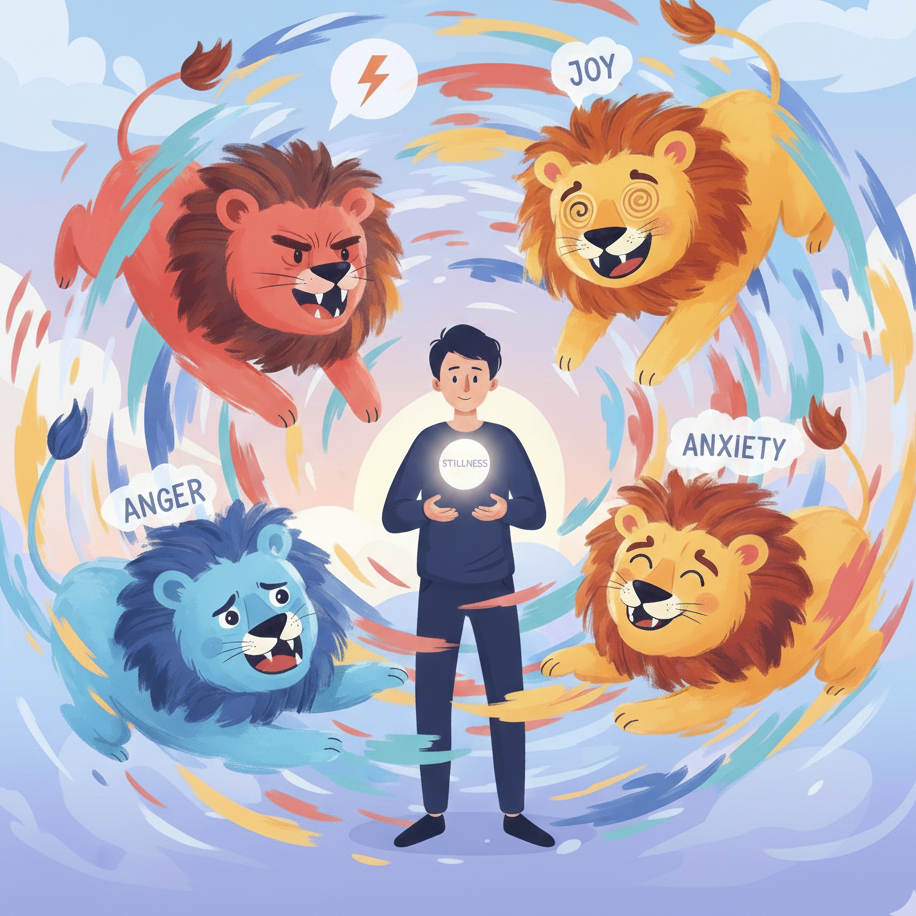
Don't get me wrong, reacting instinctively is not a bad thing; it is what has helped us survive as a human race from the dawn of creation (or evolution) till now. These instincts can be biological or learned. Let me give you some examples:
- The reflex arc: this is when your body automatically moves your hand away from an intense stimulus, like fire, extreme cold, a sharp object, or anything that could hurt you.
- The Fight-or-flight response: Your mind's automated way of helping you deal with danger. When faced with danger, your mind:
- Increases your heart rate to send more blood to your muscles.
- Increases your breathing rate to send more oxygen to your blood
- Sends adrenaline to keep you alert,
- Sends you cortisol to keep you stressed and uncomfortable - to motivate you to fight back or escape.
- Avoidance: Ignoring or withdrawing from stressful situations or people. You may have learnt this in your childhood as a way to deal with stressful issues. This is not technically an instinct but a defense mechanism, and it works the same way as our biological instincts - triggered automatically without you thinking about it, in an attempt to protect you from harm.
- Denial: A defense mechanism that makes us refuse to accept reality. This is an automatic way of protecting us from a situation or fact that is too painful to face right away.
And many more…
See, there are entire fields of study (biology, psychology, neuroscience) dedicated to studying our biological instincts and defence mechanisms. So there's no shame in struggling to control them. They are automatic by design.
However, humans have the gift of self-awareness, which gives us the power to rise above these automatic responses. Self-awareness, advanced reasoning, and our ability to speak are some qualities that separate us from animals. Patience and self-awareness play an instrumental role in overcoming our base instincts. Let's see how.
How patience helps us overcome our base instincts.
The wisdom behind patience is waiting for the emotion to pass, so you can better address the actual problem rather than reacting instinctively to the emotion itself.
Emotions are just signals (nothing more), telling you about the state of your environment as perceived by your senses and imagination. Emotions come with two properties:
- An Intensity
- An expiration time.
No matter how intense the emotion is, IT WILL PASS. So why not simply wait it out?
This is the power and beauty of patience; it gives you back control of your mind and body.
PATIENCE FEELS LIKE TIME WASTING.
If time is money, then patience is wealth - Hayford O.A
Society has convinced us that time is money and stillness is laziness. This is true in the business realm, but in the realm of patience, stillness-within and waiting are king.
Patience is not time-wasting, but using time to your advantage. Patience is one of the most effective strategies, just waiting till the time is right before taking action. It doesn't get simpler than that!. However, we find it challenging to adopt this strategy because we are not used to being still, and this inability makes waiting feel like torture.
Our grandmothers understood this concept and made their grandest requests when our grandfathers were full and in the best of moods. This way, they used time to their advantage instead of preparing a 50-page PowerPoint presentation to justify their request.
So simple.
So elegant.
Yet incredibly hard to practice.
If patience is so difficult to practice, then why bother? That is a good question. And the answer is: nothing worthwhile comes easy! In the next section, we discuss why Patience is totally worth it.
If you found this relatable, share it with a friend! Follow Bytes&Lessons for more realistic guides to understanding and navigating complex concepts.
📸 Instagram • 🐦 X (Twitter) • 📘 Facebook • 🎵 TikTok • 💼 LinkedIn Newsletter • ▶️ YouTube • 🌐 Website: bytesnlessons.com
You should also read:
Patience without losing your mind: Chapter 4 - CATALYST FOR PATIENCE.
Chapter 4 - CATALYST FOR PATIENCE. By now, we know patience starts within you, and reading all the books about patience will not magically make you patient. Patience is not learned intellectually; it is formed internally. Below are tried-and-tested approaches that will assist you on…
Continue reading...
Patience without losing your mind: Chapter 3 - THE NEED FOR PATIENCE
Chapter 3 - THE NEED FOR PATIENCE PATIENCE AS A WAY OF MANAGING OUR EMOTIONS. The body's physical reaction to an emotional trigger lasts for about 90 seconds. After this , any lingering emotion is the result of consciously or unconsciously replaying the triggering thought,…
Continue reading...
Patience without losing your mind: Chapter 1 - THE PHILOSOPHY OF PATIENCE
Chapter 1 - THE PHILOSOPHY OF PATIENCE If I were to define Patience with a word, it would be STILLNESS. The next best word will be WAITING. It is the ability to be Still Within that helps you wait for the storm to pass. It…
Continue reading...
Patience without losing your mind: INTRODUCTION
INTRODUCTION. My New Year's resolutions in 2025 were simple (or so I thought): These I prayed about and added to my calendar to assess my progress by the end of the year. I began by reading every book I could find on leadership, communication, and…
Continue reading...