Patience without losing your mind: Chapter 5 - FACTS ABOUT PATIENCE
 Hayford Owusu Ansah
Chapter 5 - FACTS ABOUT PATIENCE.
IT STARTS WITHIN, THEN MANIFESTS OUTWARD.
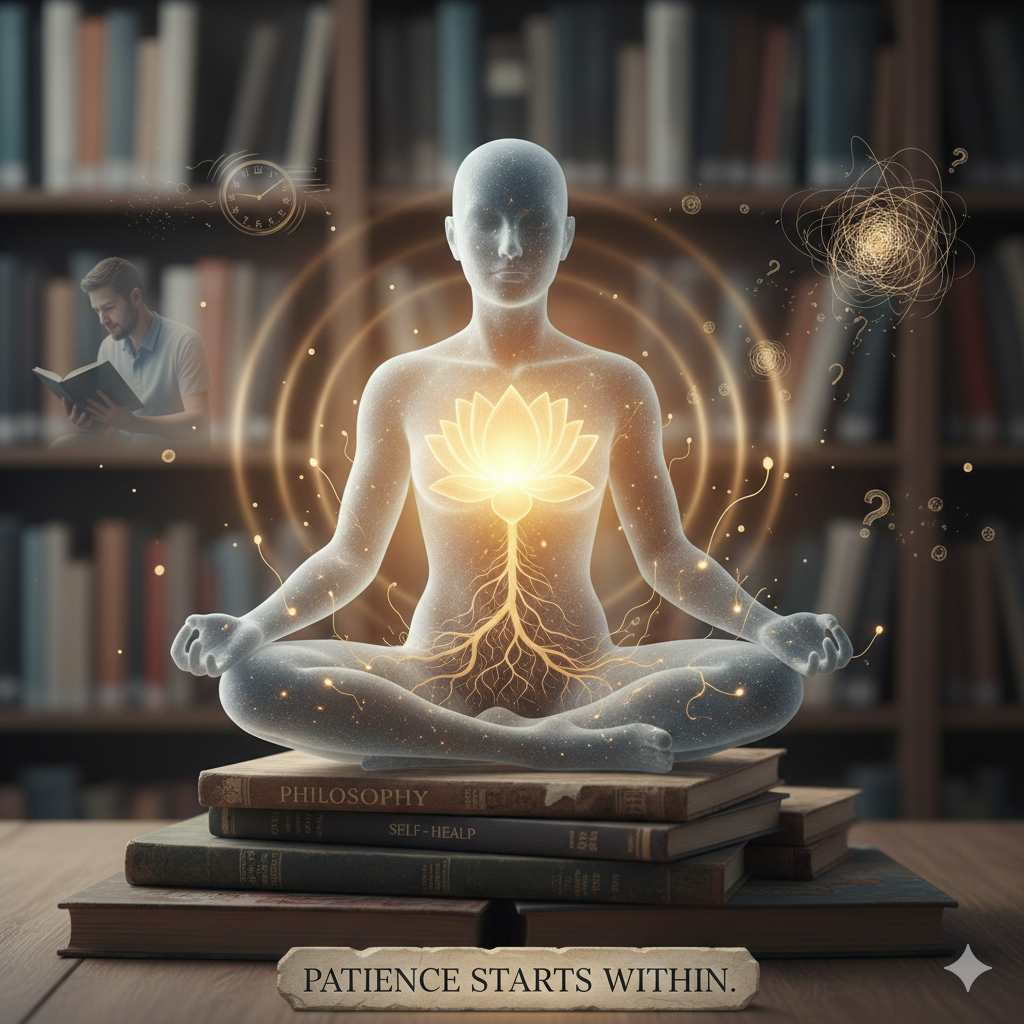
I have always admired people with patience, so I made it a personal mission to learn by observing their actions. This I did, plus a lot of reading and research. Ironically, the more intellectual knowledge I gained about this topic, the more impatient I became. This was truly discouraging until it dawned on me: Patience is a quality of the spirit, and it must start within.
It is a virtue, it is acquired, not learned.
If it could be learned like a school subject, then the smartest people would be the most patient. Unfortunately, that is never the case. In fact, the smartest people are often the most impatient.
(See Chapter 4 - CATALYST FOR PATIENCE for how this inward transformation begins).
PATIENCE IS NOT EQUAL TO SELF-CONTROL.
Before my journey to seek this virtue, I confused self-control and discipline with patience and even convinced myself that I was Patient. This was the biggest lie I told myself that year, and that lie prolonged my search for this virtue.
What then is the difference between the two?
Self-Control.
Self-control involves harnessing your willpower to command your thoughts, emotions, or actions. It is you overpowering your feelings and thoughts to do something you don't want to do, but must do.
This action is far from the inner stillness patience provides, but rather an inner battle.
Discipline.
Discipline is a consistent application of self-control to achieve a long-term goal. In simple terms, Discipline = Self-control + Consistency.
Example:
You want to lose weight in 6 months, so you commit to working out 4 times a week. There will be days when you won't feel “pumped” to work out. Consistently overpowering the feeling not to work out each day is what we call discipline.
How Self-control complements patience.
Another interesting discovery I made was how self-control complements patience. I observed that most patient people often possess self-control. So when their true patience (inner stillness) begins to run out, they can substitute it with self-control to give the outward appearance of calmness and control.
Final thoughts.
In conclusion, Patience is stillness within, and self-control is a battle within. If you are using too much energy, then it's not Patience but self-control. Self-control can take the place of patience when it begins to run out.
Ultimately, they can achieve the same goal; it is just a difference in methodology.
PATIENCE GROWS LINEARLY.
A formal metric I devised to measure patience is:
How long can someone maintain their inner stillness till it is disrupted?.
One fascinating observation I made about patience is that, when in an emotionally neutral state (not annoyed beforehand), the time it takes for a patient person’s inner stillness to be disrupted never declines, but it can grow linearly. To put it simply, a patient person will remain patient or continue to grow in patience.
I have never seen a patient person transform into a hot-tempered one, but I have seen the reverse: a hot-tempered person becoming patient.
In conclusion, the longer you can maintain your inner stillness, the higher your level of patience.
PATIENCE WALKS WITH COMPASSION, GRACE, AND SELF-CONTROL.
The truly patient people I know are quick to forgive and can empathize deeply. They are also compassionate and can give grace freely. They are the kind of people who do not get angry and forgive you when you are very late for a meeting. Impatient people struggle to give that kind of grace.
Don't be mistaken, not all patient people are saints. In fact, some of history’s calculated evil masterminds had tremendous patience. Others also use their patience as a weapon to exact vengeance at the most opportune time.
Regardless, the pattern stands: where patience is present, compassion, grace, and self-control often follow.
After discovering the correlation among these qualities (compassion, grace, and self-control), it was curious to understand this relationship. I found the answer by learning about the personality types.
In the next chapter, we explore how our natural personalities influence our capacity for patience.
If you find this relatable, share it with a friend! Follow Bytes&Lessons for more realistic guides to understanding and navigating complex concepts.
📸 Instagram • 🐦 X (Twitter) • 📘 Facebook • 🎵 TikTok • 💼 LinkedIn Newsletter • ▶️ YouTube • 🌐 Website: bytesnlessons.com